Go from idea to design faster with new generative AI features in Illustrator. Discover Generative Expand, Turntable, Text to Pattern, and more features powered by the latest Adobe Firefly Vector Model.
Spark creativity and speed up workflows with generative AI in Illustrator.
Create professional-level vector graphics to match your style, generate seamless patterns, and add details to logos in record time.
Turn rough ideas into vectors.
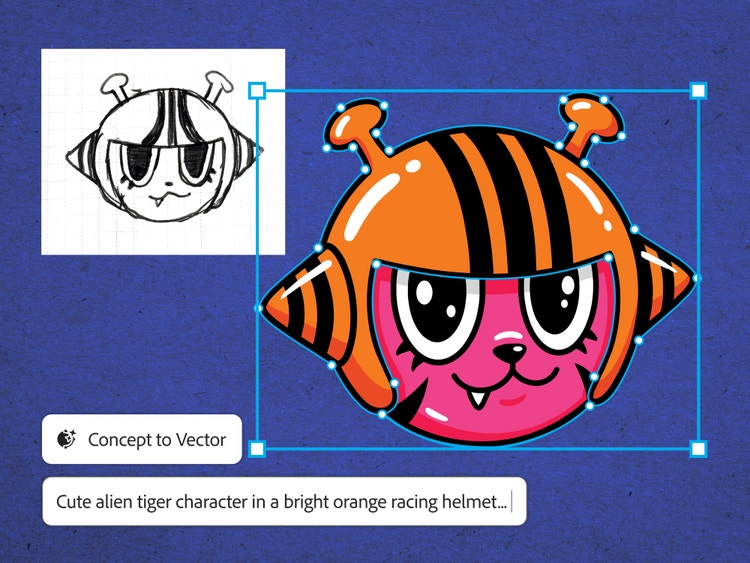
Drop a sketch or low-res image into Illustrator and start refining, not redrawing. Concept to Vector transforms outlines into editable graphics — ready to reshape, restyle, and explore new directions.
Expand your artwork seamlessly.
Maximize your productivity with new Generative Expand. Resize graphics, add bleeds, and explore concepts for professional designs.
Fill shapes fast.
Quickly fill a simple vector outline with rich detail and color that matches the look of your own artwork with Generative Shape Fill.
Ideate seamless patterns.
Start with a prompt and create endless patterns with Text to Pattern, now with improved output quality and new density controls.
Visualize it, create it.
Turn your ideas into fully editable vector graphics scenes, subjects, and icons with the smartest Text to Vector Graphic yet.
See your art from every angle, instantly.
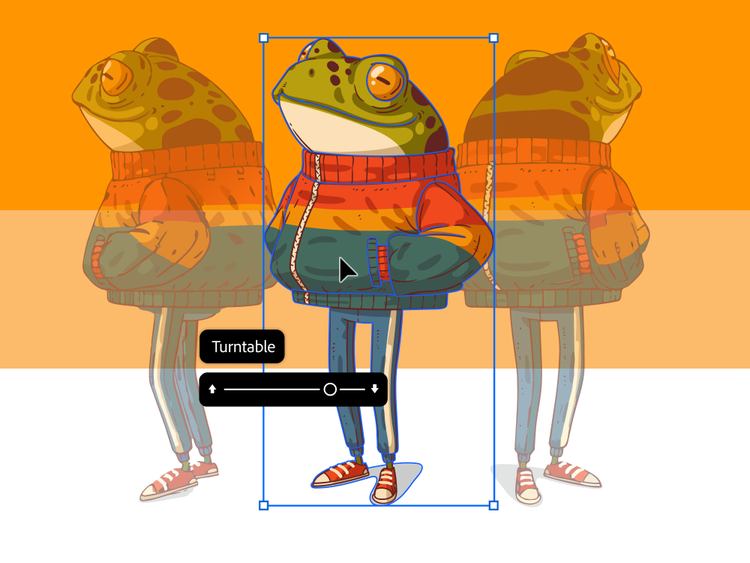
Bring new perspectives to your work with Turntable. Skip hours of redraws, refine designs, and add motion for presentations or social.
style
l spacing, static links
style
M spacing
How to use generative AI in Illustrator
AI in Illustrator can be accessed via the Contextual Task Bar or Generate Vectors in the Properties panel.
Clicking on any of the above will open up a modal where users can insert a prompt and choose outputs like Scene, Subject, Icon. In the modal, there is also a section that provides prompt inspiration if users are not sure what prompt to use.
Users will have more creative control over the generated outputs with controls like Detail Slider, Style Reference, Style Presets, and Color and Tone.

style
grid width 8, Static links, M spacing
background
#F5F5F5
Questions? We have answers.
Generative Expand is an AI-powered capability that can extend vector graphics in the style of your artwork. Use it to resize files, add print bleeds, or explore new parts of an illustration. The newly generated content can be combined with the existing artwork and is fully editable.
Illustrator is one of the Creative Cloud apps that natively integrates Adobe Firefly, Adobe’s powerful generative AI technology. Text to Vector Graphic, Text to Pattern, and Generative Shape Fill generate editable vectors that can easily be scaled.
The next generation of Text to Vector Graphic, powered by the latest Adobe Firefly Vector Model, delivers a wide variety of quality vector graphics with simple text prompts to accelerate your workflows. From easy ideation to end-to-end creation, enhanced generative AI makes using Illustrator faster than ever.
Using Illustrator's Generative Shape Fill, powered by the latest Adobe Firefly Vector Model, you can accelerate your workflows by quickly adding detailed vectors to shapes that can match the style and color of your artwork, resulting in a wide variety of vector graphics.
You can control how Adobe websites use cookies and similar technologies by making choices below. But note that if you disable cookies and similar technologies entirely, Adobe websites may not function properly.
Cookies are small text files stored by your web browser when you use websites. There are also other technologies that can be used for similar purposes like HTML5 Local Storage and local shared objects, web beacons, and embedded scripts. These technologies help us do things like remembering you and your preferences when you return to our sites, measure how you use the website, conduct market research, and gather information about the ads you see and interact with.
You can make choices in the menu below about what cookies and other technologies you want us to use on Adobe sites when you visit them from this browser. You can always change those choices later by clicking on the Cookie Preferences link at the bottom of the page.
If enabled:
We can improve your experience by tailoring the site and the content to things we think might be of interest
We can better keep track of your preferences — like what language you prefer to use
We will better understand your likely interests so we can provide you more relevant Adobe ads and content on non-Adobe websites and in non-Adobe apps
It will help us improve the performance of our website and those of our partners who use the Adobe Experience Cloud
If disabled:
We won’t be able to remember you from session to session so the experience may not be tailored to your interests
You’ll still have access to the content of the site but certain features that depend on cookies may not function
You’ll still see ads, they just may not be as relevant to you
General information
You can control how Adobe websites use cookies and similar technologies by making choices below. But note that if you disable cookies and similar technologies entirely, Adobe websites may not function properly.
Cookies are small text files stored by your web browser when you use websites. There are also other technologies that can be used for similar purposes like HTML5 Local Storage, web beacons, and embedded scripts. These technologies help us do things like remembering you and your preferences when you return to our sites, measure how you use the website, conduct market research, and gather information about the ads you see and interact with.
You can make choices in the menu below about what cookies and other technologies you want us to use on Adobe sites when you visit them from this browser. You can always change those choices later by clicking on the Cookie Preferences link at the bottom of the page.
If enabled:
We can improve your experience by tailoring the site and the content to things we think might be of interest
We can better keep track of your preferences — like what language you prefer to use
We will better understand your likely interests so we can provide you more relevant Adobe ads and content on non-Adobe websites and in non-Adobe apps
It will help us improve the performance of our website and those of our partners who use the Adobe Experience Cloud
If disabled:
We won’t be able to remember you from session to session so the experience may not be tailored to your interests
We’ll still count your use of our site and services
You’ll still have access to the content of the site but certain features that depend on cookies may not function
You’ll still see ads, they just may not be as relevant to you
Operate the site and core servicesOperate site and measure engagement
Always active
These cookies are required, and they are used to enable the site and related services core functionality. Without them the site could not operate, so they cannot be disabled.
These cookies enable the site and related services’ core functionality and collect statistics about user engagement, such as counting active use to help us understand trends. These cookies cannot be disabled.
Measure performance
These cookies are used to analyze site usage to measure and improve performance. Without them Adobe cannot know what content is most valued and how often unique visitors return to the site, making it hard to improve information we offer to you.
These cookies are used to analyze site usage to measure and improve performance. Without them Adobe cannot know what content is most valued, making it hard to improve information we offer to you.
Extend functionality
These cookies are used to enhance the functionality of Adobe sites such as remembering your settings and preferences to deliver a personalized experience; for example, your username, your repeated visits, preferred language, your country, or any other saved preference.
Personalize advertising
These cookies are used to enable Adobe and our partners to serve ads more relevant to your interests. Without them you will still see ads, but they might not be as relevant to you.